





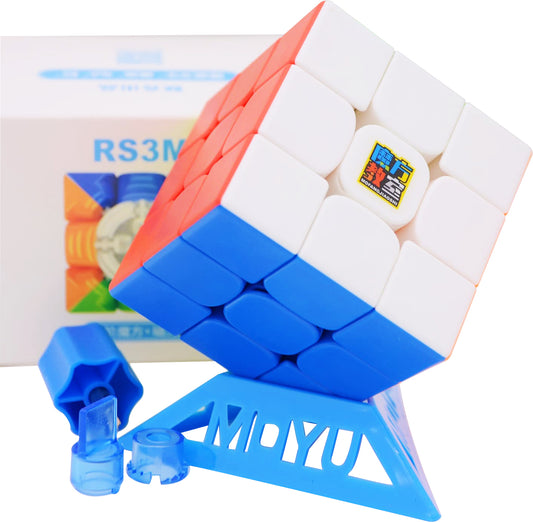


11 Best 3x3 Rubik's Cube Patterns With Algorithms & Notations
11 Best 3x3 Rubik's Cube Patterns With Algorithms & Notations
A solved 3x3 Rubik's Cube is nice to look at, but it's not the only trick your cube can do. With a short sequence of turns — called an algorithm — you can twist a fully solved 3x3 into a symmetrical pattern, snap a photo, and then reverse the same moves to bring it right back to solved. No skill in actually solving the cube is required — you just need the right notation and a bit of patience, turn by turn.
Below are 11 of the best 3x3 cube patterns to try, complete with exact algorithms and notations — from the classic checkerboard to the more intricate Superflip and Checkerboard-in-Cube combo. The little icon next to each one is a simplified preview of the shape it creates on a face — grab your own 3x3 speed cube and start from fully solved for each.
Quick Refresher: 3x3 Cube Notation
| Letter | Face |
|---|---|
| U | Up |
| D | Down |
| L | Left |
| R | Right |
| F | Front |
| B | Back |
A letter alone means a 90° clockwise turn of that face. An apostrophe (') reverses the direction, and a "2" means a 180° double turn.
11 Cool 3x3 Cube Patterns With Algorithms

The Classic Checkerboard
The simplest pattern to learn, and a great first try if you've never done one before. Every face ends up split into a checkered pattern of alternating colors.
U2 D2 F2 B2 L2 R2
Cube-in-a-Cube
This one creates the illusion of a smaller cube nested diagonally inside the larger one. It's one of the more visually striking patterns and a favorite for cubing photos.
F L F U' R U F2 L2 U' L' B D' B' L2 U
Cube-in-a-Cube-in-a-Cube
Take the previous pattern and add a third nested layer. It looks complex, but it's really just a longer, related sequence.
U' L' U' F' R2 B' R F U B2 U B' L U' F U R F'
The Anaconda
A subtle pattern — small L-shapes appear on each face rather than one big design.
L U B' U' R L' B R' F B' D R D' F'
The Plus Pattern (Cross)
This leaves a plus sign visible on every face of the cube.
R2 L' D F2 R' D' R' L U' D R D B2 R' U D2
Superflip
This is the big one. Every corner stays exactly in place, but all 12 edge pieces get flipped — it's one of the positions considered "farthest" from solved in terms of moves required, and a favorite among cubing theorists.
U R2 F B R B2 R U2 L B2 R U' D' R2 F R' L B2 U2 F2
Black Mamba
A mix of L-shapes and straight lines running across the faces.
R D L F' R L' D R' U D' B U' R' D'
Plus-Minus
Nine of the cube's twelve visible face sections show either a plus or a minus symbol once this one's done — only two sides are left untouched.
U2 R2 L2 U2 R2 L2
Green Mamba
A cleaner, line-heavy pattern that runs across all six faces.
R D R F R' F' B D R' U' B' U D2
Four Centers Swap
Rather than shuffling edges or corners, this one rotates four of the center pieces — a nice one to try once you've mastered the others and want something different.
F2 B2 U D' R2 L2 U D'
Checkerboard in Cube
The grand finale — the Cube-in-a-Cube diamond and the Checkerboard pattern combined into one design. It takes the longest sequence of the bunch, but it's the most eye-catching result on this list.
B D F' B' D L2 U L U' B D' R B R D' R L' F U2 DWhy Does This Even Work?
Every pattern above relies on two ideas:
- Preserving — a piece may move around mid-sequence, but by the last move it lands back exactly where it started.
- Inserting — other pieces get shuffled into new spots on purpose, which is what actually creates the visible design.
The checkerboard is the easiest example: the corners are preserved (they never actually change position relative to each other) while the edges get inserted into new spots, creating the alternating pattern. Once you understand that split, you can start predicting roughly what a new algorithm will do before you even try it — and eventually build your own patterns from scratch.
Frequently Asked Questions
- Do I need to know how to solve a cube first?
- No. You can apply any of these patterns straight from a solved cube without knowing a single solving method.
- Will this scramble my cube permanently?
- No — as long as you enter the moves correctly, the cube is still "solved" underneath the pattern. Reversing the sequence (do the moves backward, and reverse each turn's direction) brings it right back.
- Which pattern should a beginner start with?
- The checkerboard. Six moves, easy to memorize, and it looks great in photos.
- Can I invent my own pattern?
- Yes — once you understand preserving vs. inserting, experiment with your own sequences and see what shows up.
- What's a cube mosaic?
- A larger art piece made by arranging many individual cubes side by side, each set to a different color pattern, so that together they form a picture — similar to pixel art.


